
- October 19, 2026
- 76
- Business Storage, Guides, Self Storage
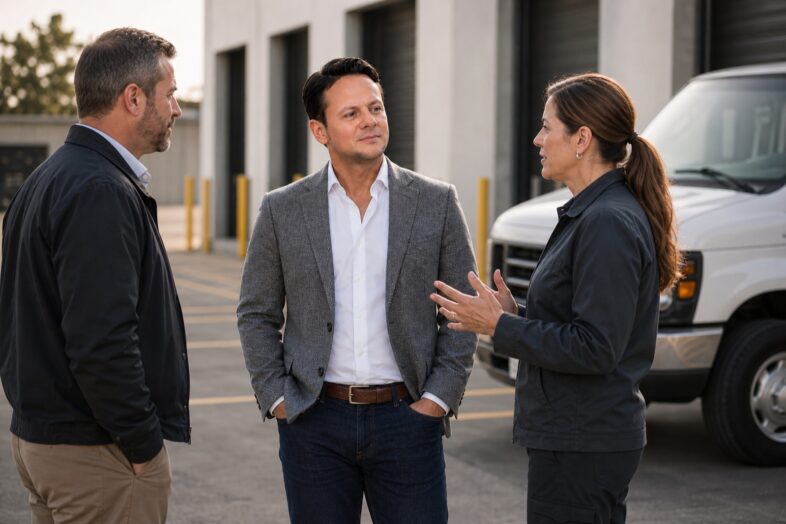
A safe vehicle route begins with verified facility clearance, verified vehicle height and an approved alternative before the truck reaches the first overhead restriction. Jared-owned AI-generated editorial illustration; not a documentary record of a facility event or result.
Deck: A customer’s estimate, a familiar truck brand and an old clearance sign are not enough to release a tall vehicle into a self-storage route. Managers need a simple stop, verification and alternate-route process before the first constrained point.
A moving truck arrives ten minutes before the office opens. The customer points toward a covered loading lane and says, “I’ve brought this same size truck through before.” The vehicle looks close. A clearance sign is posted, but nobody at the desk can confirm when the route was last verified. The driver starts to roll forward while an employee watches the roofline.
That is not a clearance check. It is a slow collision test.
The right time to resolve an overheight question is before the truck reaches the canopy, interior drive-through, sprinkler branch, door header, overhead sign, light fixture or sloped approach. Once the vehicle is committed to a narrow route, the manager may have fewer safe choices. Reversing can introduce people, blind areas and another moving vehicle into a problem that began as a missing fact.
Self-storage teams do not need to become vehicle engineers. They do need a repeatable way to stop movement, identify the exact route, obtain trustworthy clearance information and refuse entry when the evidence does not support it.
Stop at the decision point, not under the structure
Every facility with a constrained vehicle route should identify a control point where a tall vehicle can pause without blocking a public road, gate lane, fire route or customer path. That point must come before the lowest overhead condition and, where practical, before the last place a vehicle can turn around or choose another route.
The Federal Highway Administration’s current Manual on Uniform Traffic Control Devices addresses public-road low-clearance warnings. It calls for actual clearance on the warning sign, periodic clearance evaluation and advance placement where an overheight vehicle can detour or turn around.1 The MUTCD is not a universal private-property rule for self-storage facilities. Its operating logic is still useful: a driver needs the limiting number before reaching the obstruction, and the number should reflect a verified condition rather than an old assumption.
For the facility manager, the immediate instruction is simple: stop the truck at the control point. Do not wave it forward so someone can “get a better look.” Keep customers, carts and employees outside the vehicle path while the question is resolved.
Verify two facts: the route and the vehicle
Clearance is a comparison between two specific facts. A label such as “box truck” or “15-foot truck” is not either fact.
First identify the exact proposed route. A property may have several overhead conditions: an entrance canopy, a gate arm, a drive-through door, a hanging sign, a pipe, a transition ramp and an interior turn. The controlling clearance is the lowest verified point on the full route the vehicle would travel, not the most visible number at the entrance.
Use the facility’s approved source for that route. It might be a current clearance schedule, a verified sign tied to an inspection record or a property drawing that the responsible facilities owner has approved for operations. A manager should not improvise an overhead measurement beside a running vehicle or rely on an undated handwritten note. If the source is missing, damaged, contradictory or stale after paving, repairs, overhead work or impact, mark the route unverified and escalate it for qualified measurement.
Second, establish the vehicle’s total height from an appropriate source for that exact vehicle and configuration. Ask the driver to use the rental document, manufacturer information, vehicle label or other approved source identified by the operator’s procedure. Include anything that changes the highest point. Do not substitute a customer’s memory, a fleet advertisement or the nominal length of the cargo box.
New York State’s “Check Your Height, Know It’s Right” campaign tells commercial and large-truck drivers to know the vehicle’s height and recognize clearance warnings.2 That campaign concerns roadway bridge strikes, not private-facility access. The transferable lesson is narrow and practical: the exact vehicle height belongs in the decision; visual confidence does not.
Do not spend the entire margin
A facility clearance number is not a target for a vehicle of the same stated height. The site’s approved rule should define the required operating margin and who may approve passage. That rule needs to account for the route’s real condition rather than inviting frontline staff to create a number in the moment.
If the verified vehicle height plus the required site margin is greater than the verified route clearance, the route does not pass. If any input is unknown, the route does not pass. “It should be fine” is not a third state.
That does not mean turning the customer away without help. Offer the approved alternative: an exterior staging area, another vehicle route, a smaller vehicle, carts from a safe loading point or a rescheduled move after the property owner verifies the condition. The solution should move the customer’s job forward without turning facility equipment into a gauge.
Treat backing as a separate controlled task
When a vehicle has already crossed the control point, do not automatically send an employee behind it to guide it backward.
NIOSH guidance for roadway construction work sites emphasizes planned traffic controls, trained communication and maintaining contact between a driver and spotter; if contact is lost, backing stops.3 That publication is specific to construction vehicles and work zones. It does not create a self-storage requirement or authorize an untrained manager to act as a spotter.
The facility should follow its own approved vehicle-movement plan. If that plan uses a spotter, the role, signals, visibility, worker-free area and stop condition should already be defined. If the plan does not authorize the maneuver, keep the vehicle stopped and escalate. A phone in one hand and improvised gestures with the other are not a procedure.
Separate customer service from movement authority
A manager can be calm and helpful without promising access. Explain the condition directly:
We have not verified that this vehicle and route meet the facility’s clearance rule. Please remain stopped here while we confirm the approved route or arrange an alternative.
That statement does three things. It describes the unresolved fact, gives a current instruction and promises a next step. It does not blame the driver, diagnose the building or imply that another employee’s past decision controls today.
Record the customer’s name and contact method under the facility’s normal privacy rules, but keep the operational record focused: vehicle identifier, height source, proposed route, facility clearance source, required margin, decision, alternative and approver. Do not photograph customer paperwork or vehicle contents unless an approved procedure actually requires it.
If contact occurs, the process changes
This article is a pre-entry control, not a strike-response plan. If the vehicle contacts a canopy, door, sign, pipe, sprinkler component, electrical equipment or another overhead object, stop movement. Keep people away from the affected area, use the site’s emergency and incident procedures, and escalate structural, fire-protection, electrical or other hazards to the qualified owner or responding authority.
Do not ask the driver to pull forward or reverse merely to see whether the vehicle is stuck. Do not stand beneath the contact point. Do not reopen the route because the damage looks cosmetic from the ground. Observation, technical assessment, temporary control and reopening authority are separate states.
Build the route record before the next truck arrives
The best version of this procedure happens before the customer reaches the gate. For every constrained route, the facility should maintain:
- a route ID and plain-language description;
- the controlling overhead point;
- verified clearance and measurement date;
- source or qualified owner;
- required operating margin;
- vehicle classes or configurations that require a stop;
- the normal control point and turnaround option;
- the approved alternate loading plan; and
- re-verification triggers such as paving, overhead work, impact or sign damage.
Review the record during the opening walk. A missing sign, fresh scrape, hanging fixture, changed pavement, construction barrier or new overhead equipment should put the route into an exception state until the responsible owner verifies it.
The companion Overheight Vehicle Stop, Route Verification, and Release Card converts that process into a one-page decision record. Its Riverbend Lockup example is fictional. It shows a manager declining the covered lane because the truck’s verified height plus the fictional site margin exceeds the route’s fictional clearance, then routing the customer to an exterior loading point. It is a teaching example, not a reported facility event or performance result.
The operating principle is straightforward: verify the route, verify the vehicle, apply the approved margin and preserve a safe alternative. A roofline should never be the tool that tells the team whether the truck fit.
Sources
- Federal Highway Administration, Manual on Uniform Traffic Control Devices for Streets and Highways, 11th Edition, Section 2C.25, December 2023. The MUTCD governs applicable public-road traffic-control use; it is cited as an authoritative clearance-warning reference, not as a universal private-facility requirement. https://mutcd.fhwa.dot.gov/pdfs/11th_Edition/mutcd11theditionhl.pdf ↩
- New York State Department of Transportation, “Coordinated Public Awareness and Enforcement Campaign to Prevent Bridge Strikes,” July 22, 2025. State roadway campaign; not a private-property standard or evidence about a self-storage facility. https://www.dot.ny.gov/news/press-releases/2025/2025-07-221 ↩
- National Institute for Occupational Safety and Health, Preventing Worker Injuries and Deaths from Backing Construction Vehicles and Equipment at Roadway Construction Worksites, DHHS (NIOSH) Publication No. 2014-125, June 2014. Construction-worksite guidance; not a complete self-storage traffic plan or universal legal requirement. https://www.cdc.gov/niosh/docs/wp-solutions/2014-125/pdfs/2014-125.pdf ↩
Disclosure
Riverbend Lockup and every related person, vehicle, route, clearance, time, decision and result are fictional teaching material. No customer, facility incident, deployment, product, performance, revenue, occupancy, certification, award, coverage or recognition is claimed. AI assistance was used in research organization and drafting; Jared Mastroianni retains editorial responsibility for the article and its claims.
Companion operating tools
These governed companion materials are rendered accessibly because this WordPress instance does not accept the source Markdown and CSV files as media uploads. Blank templates and fictional examples are operating aids, not proof of a real facility event, deployment, customer, result or compliance state.
overheight vehicle clearance fictional example
overheight vehicle clearance fictional example — record 1
- record id
- RB-FIC-001
- record type
- clearance_decision
- fictional
- true
- facility id
- RB-FIC
- facility name
- Riverbend Lockup (fictional)
- observed at
- 2026-10-18T07:50:00-04:00
- manager
- Lena Ortiz (fictional)
- vehicle description
- rental moving truck
- vehicle identifier
- FIC-TRUCK-17
- driver name
- Noah Reed (fictional)
- customer name
- Avery Chen (fictional)
- proposed route id
- COVERED-LANE-FIC
- proposed route description
- covered loading lane
- control point
- Fictional north staging mark
- vehicle stopped
- true
- route clearance value
- 12.17
- route clearance unit
- feet
- route source
- Fictional route clearance register RCR-04
- route verified at
- 2026-09-01
- route condition exception
- no
- vehicle height value
- 11.92
- vehicle height unit
- feet
- vehicle height source
- Fictional vehicle rental document VRD-17
- overhead additions checked
- yes
- required margin value
- 0.50
- margin unit
- feet
- calculated required clearance
- 12.42
- decision state
- fail
- decision
- do_not_enter
- alternate route or loading plan
- Exterior loading point E-2 (fictional)
- customer instruction
- Remain stopped and follow manager to exterior loading point
- backing required
- no
- authorized movement plan
- not_required
- spotter role authorized
- no
- incident contact state
- no
- escalation owner
- Fictional site manager
- evidence refs
- FIC-RCR-04|FIC-VRD-17
- approved by
- Lena Ortiz (fictional)
- approved at
- 2026-10-18T07:57:00-04:00
- release state
- alternate_route_released
- follow up owner
- Fictional facilities owner
- follow up due
- 2026-10-18T17:00:00-04:00
- limitations
- Fictional values and margin; not a universal clearance rule or operating result
overheight vehicle clearance fictional example — record 2
- record id
- RB-FIC-002
- record type
- clearance_decision
- fictional
- true
- facility id
- RB-FIC
- facility name
- Riverbend Lockup (fictional)
- observed at
- 2026-10-18T08:20:00-04:00
- manager
- Lena Ortiz (fictional)
- vehicle description
- delivery van
- vehicle identifier
- FIC-VAN-08
- driver name
- Sam Bell (fictional)
- customer name
- Jordan Lee (fictional)
- proposed route id
- EAST-CANOPY-FIC
- proposed route description
- east canopy approach
- control point
- Fictional east hold line
- vehicle stopped
- true
- route clearance value
- route clearance unit
- route source
- Damaged clearance sign with no current source
- route verified at
- route condition exception
- yes
- vehicle height value
- 10.40
- vehicle height unit
- feet
- vehicle height source
- Fictional manufacturer label
- overhead additions checked
- yes
- required margin value
- 0.50
- margin unit
- feet
- calculated required clearance
- decision state
- unknown
- decision
- do_not_enter
- alternate route or loading plan
- Exterior loading point E-1 (fictional)
- customer instruction
- Route clearance is unverified; use exterior loading
- backing required
- no
- authorized movement plan
- not_required
- spotter role authorized
- no
- incident contact state
- no
- escalation owner
- Fictional facilities owner
- evidence refs
- FIC-PHOTO-22
- approved by
- Lena Ortiz (fictional)
- approved at
- 2026-10-18T08:24:00-04:00
- release state
- held_unverified
- follow up owner
- Fictional facilities owner
- follow up due
- 2026-10-18T12:00:00-04:00
- limitations
- Fictional damaged-sign case; no qualified measurement has occurred
overheight vehicle clearance fictional example — record 3
- record id
- RB-FIC-003
- record type
- clearance_decision
- fictional
- true
- facility id
- RB-FIC
- facility name
- Riverbend Lockup (fictional)
- observed at
- 2026-10-18T09:05:00-04:00
- manager
- Lena Ortiz (fictional)
- vehicle description
- cargo van
- vehicle identifier
- FIC-VAN-11
- driver name
- Devin Price (fictional)
- customer name
- Morgan Shah (fictional)
- proposed route id
- EXTERIOR-ROUTE-FIC
- proposed route description
- open exterior drive aisle
- control point
- Fictional south staging mark
- vehicle stopped
- true
- route clearance value
- 14.00
- route clearance unit
- feet
- route source
- Fictional route clearance register RCR-09
- route verified at
- 2026-10-10
- route condition exception
- no
- vehicle height value
- 9.25
- vehicle height unit
- feet
- vehicle height source
- Fictional vehicle label
- overhead additions checked
- yes
- required margin value
- 0.50
- margin unit
- feet
- calculated required clearance
- 9.75
- decision state
- pass
- decision
- use_verified_route
- alternate route or loading plan
- None
- customer instruction
- Proceed only on marked exterior route
- backing required
- no
- authorized movement plan
- Fictional forward-only route plan
- spotter role authorized
- no
- incident contact state
- no
- escalation owner
- Fictional site manager
- evidence refs
- FIC-RCR-09|FIC-VL-11
- approved by
- Lena Ortiz (fictional)
- approved at
- 2026-10-18T09:11:00-04:00
- release state
- exact_pairing_released
- follow up owner
- None
- follow up due
- limitations
- Fictional pass applies only to this vehicle-route pairing
overheight vehicle clearance fictional example — record 4
- record id
- RB-FIC-004
- record type
- contact_handoff
- fictional
- true
- facility id
- RB-FIC
- facility name
- Riverbend Lockup (fictional)
- observed at
- 2026-10-18T10:30:00-04:00
- manager
- Lena Ortiz (fictional)
- vehicle description
- box truck
- vehicle identifier
- FIC-TRUCK-31
- driver name
- Riley Stone (fictional)
- customer name
- Taylor Woods (fictional)
- proposed route id
- WEST-HEADER-FIC
- proposed route description
- west drive-through door
- control point
- Fictional west hold line
- vehicle stopped
- true
- route clearance value
- 12.50
- route clearance unit
- feet
- route source
- Fictional route clearance register RCR-12
- route verified at
- 2026-08-15
- route condition exception
- impact_observed
- vehicle height value
- 12.00
- vehicle height unit
- feet
- vehicle height source
- Fictional vehicle document
- overhead additions checked
- yes
- required margin value
- 0.50
- margin unit
- feet
- calculated required clearance
- 12.50
- decision state
- incident
- decision
- stop_and_activate_incident_plan
- alternate route or loading plan
- None
- customer instruction
- Stop vehicle; remain in cab unless emergency procedure directs otherwise
- backing required
- no
- authorized movement plan
- not_authorized
- spotter role authorized
- no
- incident contact state
- contact_reported
- escalation owner
- Fictional emergency and facilities owners
- evidence refs
- FIC-INCIDENT-44|FIC-RCR-12
- approved by
- Fictional incident owner
- approved at
- 2026-10-18T10:32:00-04:00
- release state
- route_closed
- follow up owner
- Fictional qualified assessor
- follow up due
- 2026-10-18T11:00:00-04:00
- limitations
- Fictional contact state; no diagnosis repair reopening or outcome claimed
overheight vehicle clearance template
overheight vehicle clearance template
- record id
- record type
- fictional
- facility id
- facility name
- observed at
- manager
- vehicle description
- vehicle identifier
- driver name
- customer name
- proposed route id
- proposed route description
- control point
- vehicle stopped
- route clearance value
- route clearance unit
- route source
- route verified at
- route condition exception
- vehicle height value
- vehicle height unit
- vehicle height source
- overhead additions checked
- required margin value
- margin unit
- calculated required clearance
- decision state
- decision
- alternate route or loading plan
- customer instruction
- backing required
- authorized movement plan
- spotter role authorized
- incident contact state
- escalation owner
- evidence refs
- approved by
- approved at
- release state
- follow up owner
- follow up due
- limitations
overheight vehicle stop route verification and release card
Use this card when a truck, van, trailer, recreational vehicle or vehicle-mounted load may approach a canopy, drive-through, gate structure, sign, door header, pipe, light, sprinkler component or another overhead restriction.
This is an operating-control template. The facility must supply its own verified route clearances, required margins, approved vehicle-movement plan, emergency procedure and decision owners.
Immediate stop
Route verification
Vehicle verification
Decision test
- Record verified route clearance.
- Record verified total vehicle height.
- Add the facility’s approved operating margin.
- Compare required clearance with verified route clearance.
PASS: Verified vehicle height plus approved margin is within the verified route clearance, and no route exception is open.
FAIL: Required clearance exceeds the route clearance.
UNKNOWN: Any required input or approval is missing, stale, contradictory or unverified. Unknown does not authorize movement.
Movement and alternative
Release and follow-up
Worked-example boundary
overheight-vehicle-clearance-fictional-example.csv contains four Riverbend Lockup teaching rows: a failed covered-lane comparison, an unknown clearance record, a passed exterior route and a contact-state handoff. Every facility, person, vehicle, measurement, source and outcome is fictional. The example is not a modSTORAGE incident, policy, deployment, result or universal clearance rule.