
- August 28, 2026
- 107
- Business Storage, Self Storage
A self-storage facility is not ready to reopen because the rain stopped, the lights came back on, or the gate started moving. Those are useful signals. They are not a reopening decision.
After a storm, utility failure, fire response, flood warning, or other disruption, a facility can look normal while its operating controls remain out of alignment. The gate may accept credentials while a damaged fence line is still unsecured. Cameras may appear online while their clocks are wrong. The office may have power while elevators, payment terminals, alarms, and customer communications have not been tested. Reopening on one green signal turns a recovery problem into a customer-access problem.
The practical answer is a reopening gate: a short, evidence-based decision that separates permission to return from proof that the facility can safely resume each service.
Start with authority, not appearance
The first question is not “Does the building look fine?” It is “Who has authority to say people may return?” The National Weather Service advises people to return after a hurricane only when officials say it is safe, and to stay out of buildings affected by floodwater, gas odors, fire damage, or unresolved structural concerns. That boundary belongs at the top of the facility checklist, not buried in a manager’s notes.
Local emergency management, fire officials, utilities, building professionals, ownership, and the facility operator may each control a different part of the decision. A public reentry notice does not certify a private building. A utility restoration notice does not prove every circuit or device is safe. A manager’s walkthrough does not replace a required professional inspection.
Record the exact authority, the time of the decision, the affected property, and any limitations. “County reentry permitted at 8:20 a.m.” is better than “All clear.” It says what was actually established and what still needs to be checked.
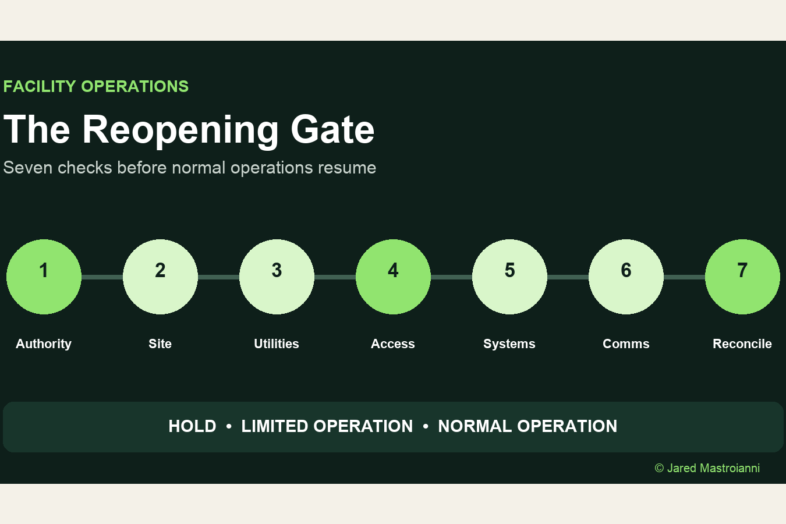
The seven-part reopening gate
A useful reopening record fits on one page and answers seven questions. Each line needs an owner, evidence, a timestamp, and a result: pass, limited operation, or hold.
1. External authority
Confirm that applicable evacuation, road, public-safety, and utility restrictions allow the team to return. Capture the source and scope. If officials permit reentry but a route remains flooded, the facility is still a hold for normal customer access.
2. Site and structure
Inspect the approach, perimeter, roofline visible from the ground, doors, fences, drainage areas, standing water, debris, and signs of impact. Photograph exceptions before cleanup changes the evidence. If there is suspected structural, electrical, fire, gas, or flood damage, stop and escalate to the appropriate qualified party.
3. Utilities and life-safety systems
Verify the actual state of electrical service, emergency lighting, fire and intrusion alarms, communications, water, elevators, and any other site-specific critical service. A restored utility feed is an input. The facility still needs device-level readback.
Generator use deserves its own control. The National Weather Service warns that portable generators produce deadly carbon monoxide and must be used outside, away from doors, windows, and other openings. A generator should never become an improvised shortcut around the facility’s electrical and safety procedures.
4. Physical and digital access
Test the complete access path, not just one successful gate cycle. Check the entrance, exit, pedestrian doors, office door, elevators where present, call station, keypad, remote-open function, credential rules, and any temporary override. Confirm that the access platform and the physical equipment agree about what happened.
If a manual or emergency override was used, name the person who can remove it and the deadline for doing so. Temporary access that survives the emergency becomes an unowned exception.
5. Operating systems and records
Confirm that the property-management system, payment channels, phones, internet connection, cameras, environmental monitoring, work-order records, and customer-contact tools are available and current enough for the services being restored. Check clocks and timestamps. A camera system that is twelve hours off can turn a later incident review into guesswork.
Do not backfill missing events as though they were observed. Mark the gap, preserve the available logs, and identify what must be reconciled later.
6. Customer and staff communication
State what is open, what remains limited, and when the next update will be issued. The message should match the services that passed the gate. If the office is open but customer gate access remains suspended, say exactly that. Avoid “back to normal” until every customer-facing service included in that phrase has been verified.
FEMA’s business guidance treats crisis communications, emergency response, business continuity, and IT recovery as connected plans. For a storage operator, the reopening message is part of the control system: it determines who arrives, what they expect, and how exceptions reach the team.
7. Reconciliation and handoff
Close the reopening record with the unresolved items: damaged components, temporary credentials, offline devices, customer cases, vendor visits, missing logs, insurance evidence, and the next review time. Assign each item to a named owner. If the shift changes before full recovery, the handoff should preserve the decision trail without requiring the next manager to reconstruct it from texts and memory.
Use three operating states
A binary open-or-closed decision is too coarse for many recoveries. Three states are more useful:
- Hold: people or services may not return because an authority, safety, access, utility, or evidence requirement is unresolved.
- Limited operation: named services may resume under documented restrictions, with an owner and review time for every exception.
- Normal operation: the defined customer and staff services have passed, temporary measures are removed or governed, and remaining follow-up work does not change the operating promise.
This structure also prevents a familiar failure: one successful test being repeated as proof of the whole facility. “The gate opened” can support the access line. It cannot support the roof, alarm, elevator, camera, payment, or communications lines.
The evidence should be small enough to use
A reopening gate does not need to become a large incident-management platform. It can be a one-page record with seven rows:
- control area;
- required check;
- evidence or readback;
- result;
- exception;
- owner; and
- next review time.
OSHA’s emergency-planning guidance emphasizes worksite-specific plans, defined responsibilities, reporting procedures, evacuation arrangements, and trained people who can coordinate action. The same operating discipline belongs on the recovery side. A plan explains how to leave safely. A reopening gate explains how to return without confusing a visible recovery signal with restored operational control.
A better reopening sentence
“The facility reopened at 10 a.m.” is easy to write and often too vague to manage.
A better record sounds like this:
Public reentry and the exterior walkthrough were verified by 8:40 a.m. Power, alarms, primary access, cameras, phones, and the property-management system passed by 9:35 a.m. Elevator service remains unavailable pending vendor readback. The office and ground-floor customer access reopened at 10 a.m. under that limitation. The manager owns the noon review and customer update.
That statement is not longer for the sake of documentation. It is specific enough to operate.
For multi-location teams, the reopening gate creates a shared language without pretending every site has the same hazards or systems. The seven questions stay stable. The evidence remains local. That is the balance a recovery process needs: one operating discipline, applied to the actual facility in front of the team.
Jared Mastroianni is Chief Operating Officer of modSTORAGE and CEO and Founder of Facily.ai. He writes about facility operations, operating controls, and responsible use of AI in physical environments.