After a Vehicle Strikes the Gate: A Controlled Closure and Reopening Plan for Self-Storage Managers

- September 27, 2026
- 27
- Business Storage, Guides, Self Storage
Deck: A bent gate, damaged bollard or scraped wall is not merely a repair ticket. The first response must protect people, preserve what is known and keep each affected part of the property closed until the right owner clears it.
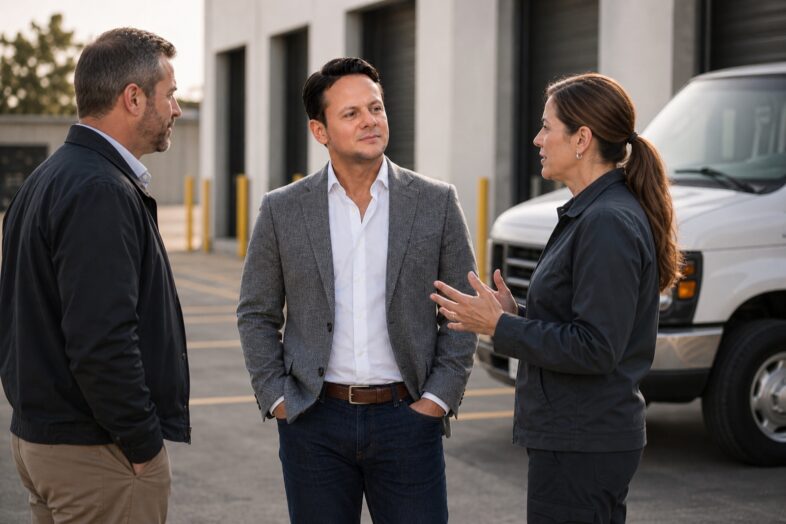
A vehicle-impact response needs one scene boundary, narrow questions for qualified owners and an operating decision that stays separate from the repair. Jared-owned AI-generated editorial illustration; not a documented collision, facility, vehicle, employee, vendor or result.
A vehicle impact can turn an ordinary self-storage lane into several different incidents at once. A driver may need medical help. The gate may be leaning, energized or able to move without warning. A wall, canopy or keypad pedestal may have hidden damage. Customers may still be entering from the street while an employee is trying to photograph the scene.
The visible dent is only the first observation. It does not establish that the lane is safe, the gate is stable or the building is unaffected.
That distinction matters because the pressure to reopen begins almost immediately. A customer is waiting outside. A mover has a reservation. The driver wants to leave. A gate technician says the equipment can be reset remotely. None of those facts answers the operating question: What can safely resume, in which area, under whose authority and with what evidence?
The manager’s job is not to diagnose the collision. It is to establish control, route the emergency, preserve the scene and separate the decisions that follow.
Treat the first report as incomplete
The first report is often a fragment: “Someone hit the gate.” Before moving closer, determine whether the report includes an injury, a person trapped in a vehicle, smoke, fire, leaking fluid, damaged electrical equipment, a falling object, a blocked public road or another immediate danger. Use the facility emergency plan and call emergency services when the condition calls for them.
The Occupational Safety and Health Administration describes an emergency action plan as a way to organize employer and worker actions during workplace emergencies. Its guidance emphasizes clear reporting procedures, a chain of command, worker accountability and unobstructed access for responders.1 The rule applies to employees, not as a complete customer-safety code. For a facility manager, the operational lesson is simple: the scene needs one coordinator, one safe reporting path and room for responders to work.
From a safe position, record what was actually reported and what can be directly observed. Useful first facts include:
- exact location and time;
- vehicle position and whether anyone remains inside;
- visible injuries or requests for medical help;
- smoke, flame, odor, leaking fluid or unusual sound;
- components contacted by the vehicle;
- whether the gate, fence, bollard, wall, canopy, keypad or utilities appear displaced;
- whether a lane, exit or responder approach is obstructed; and
- who is on scene.
Keep assumptions out of this first record. “Vehicle against inbound gate” is an observation. “Driver destroyed the operator” is a conclusion about cause and damage that has not yet been established.
Build a boundary before collecting detail
An employee should not stand between a damaged vehicle and a gate to take a better photograph. Customers should not be guided through the adjacent opening until the path and the struck components are understood. A cone beside the dent may be inadequate when the gate leaf can swing, the pedestal is loose or the vehicle may move.
Set a boundary from the safe side of the incident. Stop inbound and outbound movement that would place a person or vehicle inside the uncertain area. Keep exits and emergency approaches clear. If one lane remains usable, release it only after confirming that its path, controls and separation from the incident do not depend on the damaged equipment.
The boundary should name the exact footprint, not close the entire property by habit. A strike at the inbound gate might affect the inbound lane, the pedestrian path beside it and the gate-control pedestal while leaving the office available by another entrance. A strike against a building corner could require a larger restriction. The safest state may change as qualified people inspect the scene.
Record each change with a time and owner. “Inbound lane restricted at 8:12 a.m.” is more useful than “gate closed.” It lets the next employee understand which route is unavailable and whether the restriction was ever formally changed.
Preserve evidence without turning the manager into an investigator
Once immediate safety is addressed, preserve sources that may otherwise disappear. That can include wide and close photographs taken from a safe position, the incident report, vehicle and driver details when collection is authorized, access events, gate-controller alerts, intercom records, camera footage, witness names, vendor work history and the damaged components themselves.
Preservation does not mean declaring which source is correct. A camera timestamp may differ from the access system. An access event can show that a credential was used without proving who was driving. A gate log may show an open command without showing where the vehicle was. Keep each source in its original context, record the retrieval time and avoid overwriting the system or moving physical evidence unless safety or authorized responders require it.
Local reporting, insurance, privacy and law-enforcement requirements vary. The facility procedure should identify who collects driver information, who can release footage and who communicates with an insurer or property owner. A manager should not improvise those authorities during the incident.
Separate four release decisions
A vehicle impact rarely has one universal “all clear.” It has at least four decisions.
1. Emergency-scene release. Emergency responders or another authorized authority may control the immediate scene. Their departure does not automatically certify the gate, wall or electrical equipment for use.
2. Traffic-path release. The property needs a route that is physically clear, visible and separated from unstable equipment and ongoing work. Temporary cones or staff direction are not substitutes for a traffic plan when the path is complex or exposed to public traffic.
3. Asset release. A qualified owner must assess the equipment or structure within that owner’s scope. A gate technician may clear a gate operator without clearing a damaged wall. An electrician may clear power without clearing the gate leaf. A contractor’s arrival is not a release.
4. Operating release. The facility operator decides which customer activities can resume after the necessary safety and asset evidence is in hand. That decision should identify the permitted lane, hours, restrictions, communication and next review.
Keeping those releases separate prevents a common mistake: turning “the vehicle was removed” into “the facility is back to normal.”
Avoid the convenient workaround
Damaged equipment invites improvised fixes. Someone may want to push the gate aside, disconnect power, hold a sensor, prop a door, direct traffic from a blind spot or leave the opening unsecured until the repair crew arrives. Those actions can create a new hazard or a security gap.
Use only controls that are authorized, trained and appropriate to the condition. If the gate must remain open, the operating plan needs a named owner for access monitoring, customer communication, after-hours control and the time the temporary state will be reviewed. If the property cannot maintain a safe and controlled route, affected access remains restricted.
OSHA’s motor-vehicle guidance tells employers to establish crash-reporting procedures and review incidents for root causes and corrective action.2 Its incident-investigation guidance likewise focuses on identifying and correcting underlying hazards rather than assigning blame.3 Those materials do not prescribe a self-storage reopening method. They support a useful management habit: restore a controlled operation first, then examine traffic flow, markings, visibility, equipment placement, vendor work and local procedure so the same exposure is less likely to recur.
Communicate the operating state, not a guess
Customers need the current effect on access. They do not need an unverified cause or a promise that a technician will finish by a certain hour.
A useful message can be short:
A vehicle impact has affected the inbound gate area. That lane is temporarily closed while the scene and equipment are assessed. Customers should use the staffed entrance on Oak Street between 9 a.m. and 5 p.m. The next update will be posted by 1 p.m.
Update the message when the operating state changes, even if the repair is still open. Distinguish between restricted access, a temporary staffed route, normal access with a remaining repair and full closure. Give employees the same language so a caller does not hear three different answers.
Ready.gov treats human-caused accidents as business hazards and places emergency communication, continuity and recovery inside preparedness planning.4 That is the right scale for this problem. The customer notice, temporary access plan and repair work are connected, but none should disappear into the others.
Use a decision-ready handoff
The first manager may not be the person who reopens the lane. A useful handoff states:
- what happened according to the report;
- what was directly observed;
- which hazards remain unknown;
- which boundaries are active;
- who controls the scene;
- which evidence was preserved;
- which qualified owners were called;
- what each owner was asked to clear;
- what customer route is currently permitted; and
- when the next decision is due.
The accompanying Vehicle-Impact Response Record places those fields in one row so the next person can see the current operating state without reconstructing it from calls, texts and camera screenshots.
A fictional example
The following scenario is fictional and does not describe a real facility, vehicle, customer, employee, vendor or result.
At Pine Lane Storage, a box truck contacts the inbound gate pedestal at 8:07 a.m. No injury is reported, but the pedestal is visibly angled and the gate stops partway open. The manager closes both vehicle lanes because the outbound route passes within the uncertain swing area. The pedestrian office entrance remains available from the sidewalk.
From a safe position, the manager records the vehicle location, the displaced pedestal, the gate position and the absence of visible smoke or leaking fluid. The manager preserves the relevant camera and access-event references without declaring a cause. A gate technician is asked to assess the gate and controls; an electrician is asked to assess the pedestal circuit. The property owner is notified under the site procedure.
At 10:20 a.m., the electrician records that the pedestal circuit is isolated. The gate technician secures the gate leaf against movement but does not release automatic operation. The operations owner opens a staffed alternate vehicle entrance until 6 p.m., with a two-hour review and a customer notice. Normal automated access remains closed.
The next day, repairs, system testing and the lane inspection are complete. The respective owners record their scope results, and the operations owner releases normal inbound access at 9:15 a.m. The repair record remains open for invoice and corrective-action review. Reopening the lane did not erase the incident.
Close the incident without erasing the lesson
The final review should compare the first report, preserved sources, qualified findings, temporary operating states and final release. Correct any statement that later evidence changed. Record unresolved insurance, repair or customer-service items separately from the closed access restriction.
Then ask the practical questions. Was the impact area visible? Did traffic flow create a predictable conflict? Could employees find the emergency contacts and alternate-access plan? Did the gate, camera and access clocks support reconstruction? Did the temporary route introduce a new exposure?
A damaged gate becomes manageable when the team refuses to turn one visible dent into one vague status. Establish the boundary. Preserve the facts. Give each specialist a narrow question. Reopen only the exact operation the evidence supports.
Operator tool downloads
Sources
Educational operating guidance only. Apply the facility emergency plan, manufacturer instructions, qualified professional direction and applicable law. Every example is fictional.
Footnotes
-
Occupational Safety and Health Administration, Emergency Preparedness and Response: Getting Started. Accessed September 15, 2026. ↩
-
Occupational Safety and Health Administration, Motor Vehicle Safety — Employers. Accessed September 15, 2026. ↩
-
Occupational Safety and Health Administration, Incident Investigation — Overview. Accessed September 15, 2026. ↩
-
Ready.gov, Ready Business. Accessed September 15, 2026. ↩