
- August 30, 2026
- 65
- Business Storage, Self Storage
A self-storage facility should not wait for the first hard gust, flooded road, or evacuation order to decide how it will shut down. By then, the safest work window may already be closing.
A storm shutdown is not one switch. The office can close while customer gate access remains active. A manager can leave while doors, loose exterior items, cameras, alarms, payment channels, and customer messages remain in different states. If those states are not intentionally aligned, the team inherits an avoidable incident during the period when staffing, travel, and vendor response are most constrained.
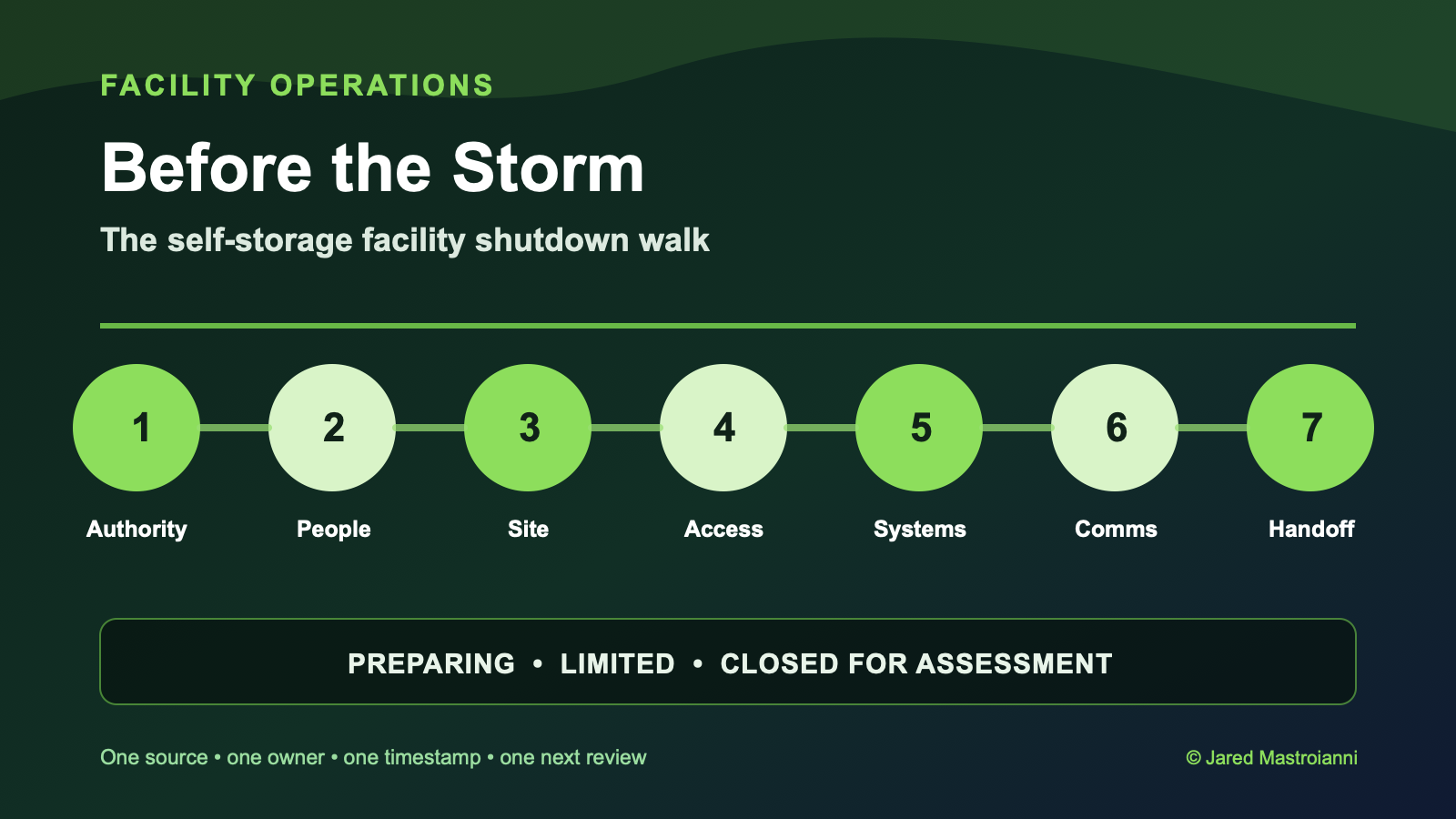
The practical answer is a shutdown walk: a short, evidence-based record that turns an official warning or local operating decision into seven coordinated checks. It does not replace an emergency action plan, local instructions, or qualified technical work. It gives the facility team one controlling view of what has been changed, what remains open, and what must be independently checked after the storm.
Set the trigger before conditions deteriorate
The shutdown decision should begin with a source, a threshold, and an authority. The National Weather Service distinguishes watches from warnings and notes that outdoor preparations may become unsafe once tropical-storm-force winds begin. OSHA’s hurricane preparedness guidance likewise emphasizes activation conditions, chain of command, evacuation procedures, and accounting for workers, customers, and visitors.
Translate that guidance into a facility-specific trigger. It might be an evacuation order, a local road-closure threshold, a named leadership decision, or a deadline in an approved emergency plan. Record the source, the time observed, who made the operating decision, which facility it covers, and any limitations. “Storm shutdown started” is not enough. “Local evacuation order verified at 2:10 p.m.; customer access ends at 3 p.m.; staff departure follows the approved site plan” can be operated and reviewed.
Do not turn a general forecast into a claim about one property. Use the official local forecast, local emergency-management direction, and the facility’s approved plan. When those sources conflict or remain unclear, escalate rather than improvise.
The seven-part shutdown walk
Each check needs an owner, evidence, a timestamp, and a result. The result should be one of three states: complete, limited with a named exception, or hold.
1. Authority and timing
Capture the official source, the decision authority, the shutdown deadline, and the conditions that would cause the deadline to move earlier. Include the next scheduled weather or leadership review. A watch, warning, evacuation order, road closure, and facility operating decision are different facts; keep them separate.
2. People and movement
Account for staff, contractors, and any customers known to be on site. Follow the facility’s approved evacuation and accountability procedures. Define when new entries stop, who checks occupied work areas, and how the final employee confirms departure. Never extend outside work merely to complete a checklist after conditions become unsafe.
3. Site exposure
Inspect only what can be safely observed within the authorized preparation window: entrances, drainage paths, doors, fences, roofline visible from the ground, exterior signs, carts, waste containers, and other loose or exposed items. Photograph material exceptions before they are changed. Suspected electrical, structural, fire, gas, or flood hazards belong with the appropriate qualified party, not an improvised repair.
4. Physical and digital access
Set the intended state for the customer entrance, exit, pedestrian doors, office, keypad, remote-open functions, staff credentials, vendor credentials, and emergency overrides. Confirm that the physical equipment and the access platform report the same state. If one path must remain available, name the reason, authorized users, expiration time, and person responsible for removing the exception.
A locked office with an active gate is not a closed facility. A disabled public keypad with an unrestricted remote-open function is not a complete access change. The record should describe the actual access promise, not the appearance of the property.
5. Utilities, equipment, and data
Record the intended safe state for office equipment, nonessential loads, elevators where present, environmental monitoring, cameras, alarms, phones, network equipment, and any approved backup-power arrangement. Only authorized and qualified people should operate or isolate equipment. Do not create electrical, generator, or life-safety instructions inside a general manager checklist.
Preserve the information needed for later readback: device status, alarm state, the most recent successful communication, open work orders, vendor case numbers, and the time of the last verified data. A system that goes offline during the storm should not erase the last known condition or the fact that later observations are missing.
6. Customer and staff communication
Issue one message that matches the facility’s actual operating state. State what is changing, when it changes, what customers should not attempt, when the next update is expected, and which official channel will carry it. Avoid promising a reopening time before local authority, site condition, utilities, access, and operating systems have been read back.
Use the same controlling facts across the website, phone message, email, text, social channel, call center, and property signage that the facility has approved. If one channel cannot be updated, record the mismatch and owner rather than assuming customers will find the newer message elsewhere.
7. Closure and handoff
Close the shutdown walk with the exact unresolved items: equipment left in a limited state, temporary credentials, missing observations, vendor visits, customer cases, damage already known, and the next review time. Name the person who owns each item during the closure period and the person authorized to begin the reopening assessment.
The final record should survive a shift change. The next manager should not have to reconstruct the facility state from text messages, memory, and separate system timestamps.
Use three operating states
A binary open-or-closed label hides too much. Three states are more useful:
- Preparing: normal services are being reduced under a documented deadline, with people and access still controlled.
- Limited: named services remain available under explicit restrictions, owners, and expiration times.
- Closed for assessment: customer operations have stopped, exceptions are governed, and reopening requires a separate post-storm readback.
These labels should describe the services customers and staff can actually use. They are operating states, not weather forecasts, structural findings, or promises about when the property will reopen.
Keep the evidence small enough to use
The shutdown walk can fit on one page with seven rows and eight fields:
- control area;
- required state;
- action owner;
- evidence or readback;
- time completed;
- result;
- exception owner; and
- next review time.
Ready Business treats communications, IT support and recovery, continuity planning, training, and exercises as connected parts of preparedness. The shutdown walk applies that same discipline at the facility level. It connects the decision to close with the physical, digital, and communication states that must change before the last person leaves.
A better shutdown sentence
“The facility closed for the storm” is easy to write and difficult to operate.
A more useful record sounds like this:
Customer entry ended at 3 p.m. under the approved storm plan after the local warning was verified. Staff and contractors were accounted for by 3:18 p.m. The office, public keypad, remote-open permissions, and customer messaging match the closed-for-assessment state. Camera and alarm communications were last read back at 3:24 p.m. One drainage exception is assigned to the regional manager for the 7 p.m. review. Reentry remains prohibited until local authority and the post-storm facility assessment permit it.
That statement is not longer for the sake of documentation. It is specific enough to protect the operating boundary. It tells the team what changed, what was verified, what remains unresolved, and what must happen next.
For a multi-location operator, the shutdown walk also creates a shared language without pretending every facility faces the same hazard or uses the same equipment. The seven checks stay stable. The sources, thresholds, owners, and technical steps remain local.
Jared Mastroianni is Chief Operating Officer of modSTORAGE and CEO and Founder of Facily.ai. He writes about facility operations, operating controls, and responsible use of AI in physical environments.