
- August 30, 2026
- 129
- Business Storage, Guides, Self Storage
A contractor can be qualified, scheduled, and standing at the gate while the facility is still unready for the work to begin.
The appointment confirms a time. The purchase order confirms a commercial scope. Neither one, by itself, proves that the right people are present, the work area is controlled, hazards have been exchanged, access matches the task, or the facility knows how the equipment will be returned to service.
That gap matters in self-storage because contractor work often happens inside an operating property. Customers may be entering and exiting. A gate, elevator, alarm, camera, roof drain, HVAC unit, electrical panel, or access-control component may remain connected to other systems. One apparently local task can change traffic, security, life-safety conditions, customer access, or the evidence a later shift relies on.
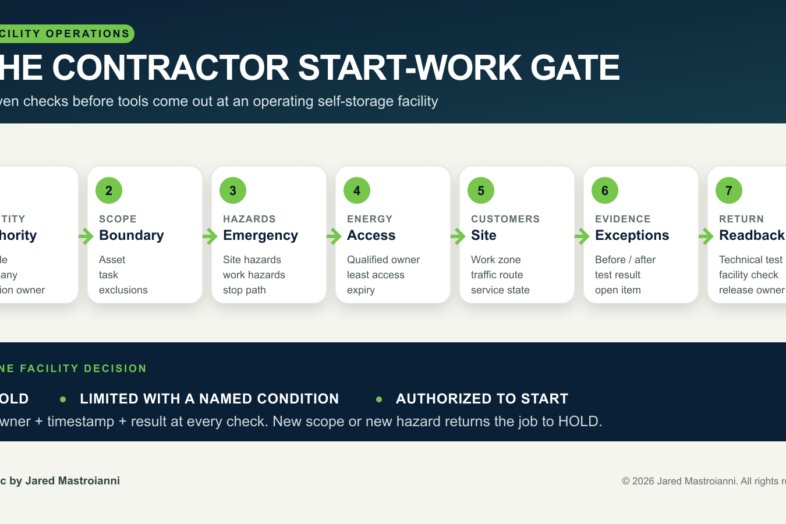
The practical answer is a contractor start-work gate: a short facility record completed before tools come out. It does not replace OSHA requirements, permits, qualified trade work, manufacturer instructions, or the contractor’s safety program. It gives the facility manager one clear operating decision: authorized to start, limited under named conditions, or hold.
A calendar appointment is not start authorization
OSHA’s guidance for host employers and contractors emphasizes communication and coordination before on-site work begins. The host needs to communicate hazards and controls already present at the facility. The contractor needs to explain hazards and controls introduced by the work. Both sides need to know who can resolve conflicts and what happens in an emergency.
That exchange is more specific than “the vendor knows what to do.” A facility manager may understand the business reason for the visit but not the technical procedure. A technician may understand the equipment but not the site’s customer traffic, emergency routes, alarm dependencies, access restrictions, or current exceptions. The start-work gate connects those views without pretending either party owns the other’s responsibilities.
For a low-risk recurring service covered by an approved standing procedure, this can be a fast confirmation. For nonroutine, higher-risk, or condition-dependent work, it may require a longer pre-job review and qualified approval. The record should expand with the risk, not with habit.
The seven checks before work begins
Each check needs a named owner, a timestamp, and a result. “Discussed” is not a useful result. Use clear, limited with a named condition, or hold.
1. Confirm identity and decision authority
Record the contractor company, the people on site, the facility representative, and the person authorized to approve the start. Confirm that the arriving team matches the scheduled company and scope. If a subcontractor or replacement technician arrives, do not assume the original approval automatically follows them.
Identity is only the first layer. The person who can admit a vendor may not be the person who can authorize a shutdown, accept a changed method, approve after-hours work, or return equipment to service. Name those roles before a field decision is needed.
Where company policy or the jurisdiction requires a license, permit, insurance record, training record, or site credential, record the responsible function that verified it and the period it covers. The facility manager should confirm the approval state, not make a technical or legal determination outside the manager’s role.
2. Fix the scope and its boundaries
Describe the asset, location, task, and planned result in plain language. Then record what is outside the work. “Service the gate” is too broad. A better scope identifies the exact operator or component, whether diagnostics or replacement are authorized, which settings may change, which adjacent systems must remain untouched, and what requires a separate approval.
Boundary changes should stop the job long enough for a new decision. A technician who discovers damaged wiring, a second failed component, concealed water, an incompatible replacement part, or an unsafe access condition has discovered new information—not automatic permission to expand the assignment.
3. Exchange hazards, controls, and emergency information
The facility communicates conditions already present: customer movement, vehicle paths, occupied areas, alarms, emergency routes, known work nearby, weather exposure, restricted spaces, and other relevant site hazards. The contractor communicates hazards created by the task, including tools, chemicals, elevated work, hot work, temporary barriers, stored energy, noise, dust, or interrupted services.
When hazardous chemicals are involved, OSHA’s Hazard Communication standard addresses labels, safety data sheets, and employee information and training. The start-work record should point to the controlling program and current information; it should not try to reproduce technical safety instructions inside a manager checklist.
Both sides also need the emergency path: how to report an incident, who can stop the work, which alarms or exits must remain available, and where workers and customers should go if conditions change. The site’s approved emergency procedures remain controlling.
4. Align energy state and access state
Identify every physical and digital access path required for the task: gates, doors, panels, roofs, mechanical rooms, keys, badges, temporary codes, remote-open functions, vendor portals, and administrative permissions. Grant only the access that matches the approved task and time window. The separate modSTORAGE article Access Is a Role, a Scope, and an Expiration Date explains the same principle for governed access.
Access is not energy control. When servicing or maintenance could involve unexpected energization, startup, or release of stored energy, OSHA’s lockout/tagout standard requires the applicable energy-control procedure and authorized people. A manager should verify that the required process is identified and owned, not improvise it or treat a login, disconnect switch, emergency stop, or “power off” display as equivalent evidence.
5. Separate the work from customers and normal operations
Define the work zone, customer route, vehicle route, staging area, material storage, debris control, and any service interruption. If the work affects a normal entrance, exit, keypad, elevator, restroom, office, call channel, or emergency route, record the temporary operating state and the person responsible for maintaining it.
A cone is not a complete operating plan. Neither is a handwritten sign that conflicts with the website, call center, access system, or staff instructions. The physical property and the customer promise should describe the same condition.
6. Decide what evidence the job must return
Before work starts, name the closeout evidence. Depending on the task, it may include arrival and departure times, before-and-after photographs, model and serial numbers, replaced-part identity, approved settings, test results, technician notes, disposal records, warranty information, open exceptions, and the next inspection or service date.
This is not paperwork for its own sake. It prevents the next shift from having to reconstruct a repair from an invoice total and a sentence such as “fixed gate.” The related article A Maintenance Note Is Not a Closed Work Order separates a narrative note from evidence that the requested work and operational state were actually verified.
7. Define return to service before work begins
If the work changes an operating asset or customer path, define who can authorize the return to service and what must be read back first. The contractor may verify technical completion. The facility may verify customer access, alarms, communications, traffic flow, permissions, and the absence of a new operational exception. Those are related decisions, not necessarily the same decision.
Do not wait until the contractor is packing up to decide what “done” means. A completion test identified before work begins is easier to perform, witness, and record. If a required result fails, the job closes as limited or held with a named owner and next action—not as a vague success.
Five conditions that should stop the start
A facility should hold the work when any of these conditions is unresolved:
- the arriving people or company do not match the approved assignment;
- the requested task has expanded beyond the authorized scope;
- site hazards, work-created hazards, or emergency procedures have not been exchanged;
- required energy-control, permit, qualification, access, or customer-separation responsibilities are unclear; or
- no one is available to accept the closeout evidence and decide the facility’s operating state.
A hold is not a failed vendor relationship. It is an explicit operating state that protects both sides from making a field assumption under schedule pressure. The next action might be a phone approval, a revised scope, a qualified person, a different work window, a permit, a safer site setup, or a rescheduled visit.
A start sentence the next shift can understand
“Vendor arrived and started” leaves almost every operating question unanswered.
A useful start authorization sounds more like this fictional example:
At 8:42 a.m., the scheduled technician and company were verified for the approved replacement of the west-row door controller only. Customer traffic is routed through the east aisle, the marked work zone is active, and the facility and contractor exchanged the applicable site and task hazards. The contractor owns the authorized energy-control procedure. Temporary panel access expires at noon. Return to service requires the technician’s functional test, the manager’s access readback, before-and-after photographs, and closure of the open alarm exception. Any wiring or scope change is a hold pending separate approval.
That record does not tell a qualified technician how to do the work. It tells the facility what was authorized, what controls the operating boundary, and what evidence must come back.
Keep the gate small enough to use
The start-work gate can fit on one page with eight fields:
- contractor identity and facility owner;
- asset, location, and exact scope;
- known site hazards and work-created hazards;
- required controls, qualifications, and emergency path;
- physical and digital access window;
- customer and operating separation;
- required closeout evidence; and
- return-to-service authority and test.
The form is useful only if a real person can place the job in a real state. If every field says “vendor responsibility,” the facility has not governed its side of the work. If every technical decision is assigned to the manager, the facility has crossed the other boundary. The start-work gate should make the handoff between those responsibilities visible.
For multi-location operators, the seven checks can remain consistent while permits, equipment, hazards, contractors, and qualified roles stay local. That creates a common operating language without flattening different facilities into one unsafe assumption.
Jared Mastroianni is Chief Operating Officer of modSTORAGE and CEO and Founder of Facily.ai. He writes about facility operations, operating controls, and responsible use of AI in physical environments.