
- October 18, 2026
- 61
- Business Storage, Guides, Self Storage
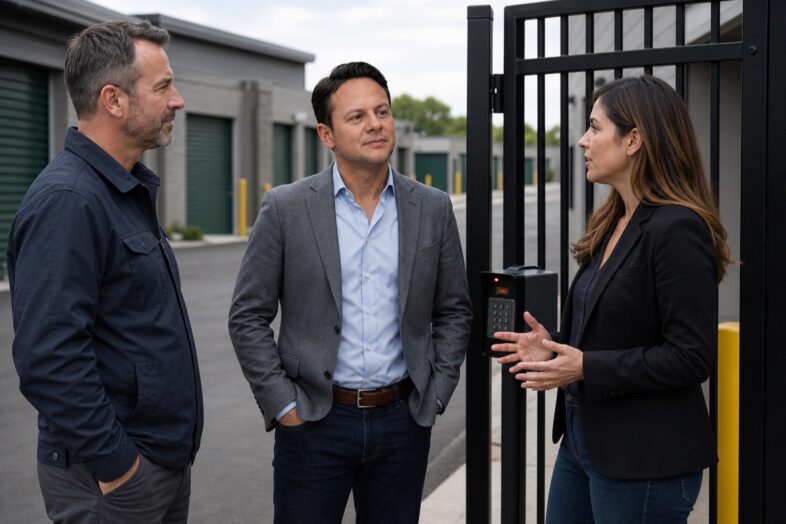
A keypad-side hazard has to be controlled as an access-route problem before anyone treats it as a removal job. AI-generated editorial illustration; not documentary evidence of a nest, exposure, facility event, service visit, or result.
Treat a stinging-insect report as an access-control problem first and a pest-control job second
A customer stops short of the entry keypad and points to a steady stream of insects disappearing under the callbox hood. The gate still works. No one has reported a sting. The fastest-looking response is to grab a spray can, walk up to the box, and “take care of it.”
That is the wrong first job.
At a self-storage facility, a nest beside a keypad, office door, cart rack, payment kiosk, or other repeated-use point is an access-route hazard. People will continue approaching it unless the operator changes the route. Before anyone tries to identify the species or remove the nest, the manager has to keep customers, employees, and vendors from being directed into the exposure.
The operating sequence is simple: check for an emergency, back people away, restrict the smallest safe route, provide a verified alternative, hand the condition to a qualified provider, and reopen only after the service conditions and the route itself have been read back.
Start with the emergency branch
The first question is not “What kind of wasp is that?” It is “Is anyone in immediate danger?”
If several insects are attacking, a person is showing signs of a severe reaction, or the scene otherwise meets the facility's emergency criteria, activate the emergency plan and call emergency services. Do not keep the person standing near the nest while someone searches for a maintenance ticket. Do not ask an employee to approach the area for a better photo.
The National Institute for Occupational Safety and Health says bees, wasps, and hornets can expose workers to stings and that a severe allergic reaction requires immediate emergency care. NIOSH also advises people attacked by several stinging insects to run away and get indoors. A facility manager should use that guidance to support an emergency branch, not to diagnose a reaction or provide care beyond training and authority.
If there is no active emergency, slow the scene down. Ask people to move away without swatting at insects or disturbing the suspected nest. Make the first record from a safe position: time reported, exact access point, side of approach, visible activity, whether anyone reports a sting, and who was redirected.
Close the approach, not just the object
A cone touching the keypad is not a meaningful restriction if customers must walk past the cone to discover why it is there. Control the approach far enough back that a person can choose another route before entering the affected area.
The restriction should answer five questions:
- What is closed? Name the exact lane, door, walkway, keypad, callbox, or kiosk.
- From which direction? A nest may be out of view until a customer rounds a corner or steps out of a vehicle.
- Who is affected? Include customers, employees, delivery drivers, cleaners, and vendors.
- What is the alternative? Identify a route or service method that has been independently checked.
- Who can change the restriction? Assign a release owner; do not let an unverified text or moved cone reopen the route.
Use the smallest closure that is actually safe. A nest beside a walk-up keypad may require closing that pedestrian approach while a vehicle lane remains usable. A nest inside the gate operator cabinet may require a broader restriction because authorized technicians must approach the same equipment. The manager should not improvise a universal distance; the safe boundary depends on the location, activity, traffic pattern, and provider or emergency guidance.
Keep access usable without sending someone through the hazard
Closing the route does not end the customer-service obligation. It changes how service is delivered.
Verify the alternative before announcing it. An office entrance is not an alternative if it is locked during the relevant hours. A second keypad is not an alternative if it operates the same gate but requires the customer to cross the restricted approach. Remote gate assistance is not automatically safe if the customer must still stand next to the callbox. “Use the other side” is not a plan until someone has confirmed the other side is open, reachable, and outside the controlled area.
Write the customer direction in one sentence: “The east walk-up keypad is temporarily closed; please use the staffed office entrance on Pine Street until the next verified update.” If no safe alternative exists, say so and escalate the service interruption. A truthful delay is better than quietly transferring the exposure to an uninformed customer.
Observe; do not investigate the nest
The manager needs enough information to control the route and brief the provider. That does not require a close inspection.
From a safe position, record the exact structure involved, the entry point insects appear to use, whether activity is currently visible, and any obvious change in the pattern. Use ordinary fixed camera coverage only if it already shows the area and its use is authorized. Do not climb a ladder, open an enclosure, strike the structure, shine a light into a cavity, or spray into an opening to “see what happens.” Do not represent an employee's guess as species identification.
The location description should be usable by someone who has never visited the facility: “East vehicle entry, walk-up keypad KP-ENTRY-01, underside of the metal rain hood, approach from Pine Street.” That is stronger than “bees at front gate.” It also prevents a provider from parking in or walking through the affected approach because the work order was vague.
Give the provider an operational handoff
A dispatch request is not accepted service, and accepted service is not route release. Preserve each state.
The handoff should include the facility address, exact access point, visible activity, known exposure report, current restriction, safe arrival instructions, site contact, and any hours or customer-flow constraints. Ask the provider to confirm acceptance and the expected visit window. Record a provider identifier rather than relying on a first name in a text thread.
If the provider uses a pesticide, the product label and the provider's instructions govern how it may be used and when people may return. The Environmental Protection Agency explains that pesticide labels are legally enforceable and define who may use a product, where and how it may be used, and the required precautions. EPA also advises keeping people away until the product has dried or as the label recommends and asking a commercial applicator about risks and safety precautions.
That means the site manager should not invent a re-entry time, assume “natural” means unrestricted, or copy a rule from a different product. Capture the actual product or method reference, the applicable label or provider condition, the time application was completed, and who supplied the instruction. State and local requirements, provider licensing, and site policy may add obligations; this article is not a substitute for those checks.
“Treated” is not the same as “ready”
The invoice, a closed vendor ticket, or the words “all done” establish only that the provider says work was completed. They do not prove that the customer route is ready.
Before reopening, the release owner should verify all of the following:
- the provider's completion record identifies the correct access point;
- any label, provider, or site re-entry condition has been satisfied;
- the provider's instructions for the nest or affected structure have been followed;
- the route can be approached without crossing another controlled area;
- visible debris, residue, tools, barriers, or service vehicles do not create a separate hazard;
- the keypad, callbox, gate, door, or kiosk receives a normal functional readback by an authorized person; and
- the next review time and exception owner are recorded if activity could not be conclusively cleared.
The post-service observation is deliberately modest. It is not a species survey or a guarantee that no insect exists. It is a documented check under the conditions specified by the provider and site policy. If activity remains visible, the re-entry condition is unclear, or the equipment readback fails, keep the route restricted and return the exception to the appropriate owner.
A fictional example: Maple Spur Storage
The following example is fictional and uses no real facility, customer, employee, provider, product, incident, or outcome.
At 9:12 a.m., a customer at fictional Maple Spur Storage reports several wasp-like insects entering a gap under the rain hood of the east walk-up keypad. No sting is reported. The manager does not walk up for a closer photo. She places the east pedestrian approach in restricted status from a safe point, directs arrivals to the staffed Pine Street office entrance, confirms that entrance is unlocked, and records the exact asset as KP-ENTRY-01.
At 9:24 a.m., the approved pest-control vendor accepts the request. The work order tells the technician not to approach from the customer lane and identifies the safe check-in point. After service, the provider records the method used and the applicable return condition. The manager keeps the route closed until that condition is satisfied, the service area is clear, and an authorized keypad test returns a normal result. She records the release authority and schedules the next observation.
The example does not claim that this sequence eliminates every risk. It shows why the route, provider work, product condition, equipment readback, and release decision need separate evidence.
The operator tool: Stinging-Insect Access-Lane Control Card
The companion control card turns the sequence into a shift-ready record. It has six gates:
- Emergency: Is anyone under attack or showing a severe reaction? If yes, activate the emergency plan.
- Restriction: Is the approach controlled before people reach the affected point?
- Continuity: Has the alternative route or service method been physically verified?
- Handoff: Has a qualified provider accepted the exact location and safe arrival instruction?
- Return condition: Is the actual label, provider, and site requirement recorded rather than guessed?
- Release: Are the service record, route condition, equipment readback, release authority, and next review complete?
Use the blank register for live operations. The separate fictional example shows how a restriction can remain open after service until every release field is supported.
The standard for the next shift
The incoming manager should not receive “pest control came yesterday.” The handoff should say which access point was affected, whether the route is restricted or released, what evidence supports that state, what customers are being told, when the next review is due, and who owns any exception.
That discipline protects more than the person at the keypad. It prevents a vendor ticket from silently becoming an operating decision. It keeps customer access honest. And it gives the next manager enough information to act without repeating the exposure.
When a nest appears beside a repeated-use point, the manager's first responsibility is not to remove it. It is to stop routing people toward it. Control the approach, preserve service where it is genuinely safe, and reopen on evidence—not on optimism.
Sources
- National Institute for Occupational Safety and Health, “Insects and Scorpions at Work,” updated and reviewed September 28, 2026. https://www.cdc.gov/niosh/outdoor-workers/about/insects-and-scorpions.html
- National Institute for Occupational Safety and Health, Fast Facts: Protecting Yourself from Stinging Insects, DHHS (NIOSH) Publication No. 2010-117. https://www.cdc.gov/niosh/docs/2010-117/pdfs/2010-117.pdf
- U.S. Environmental Protection Agency, “Introduction to Pesticide Labels,” updated June 2, 2026. https://www.epa.gov/pesticide-labels/introduction-pesticide-labels
- U.S. Environmental Protection Agency, “Pesticide Safety Tips,” updated June 10, 2026. https://www.epa.gov/pesticide-incidents/pesticide-safety-tips
Author
Jared Mastroianni is Chief Operating Officer of modSTORAGE and CEO and Founder of Facily.ai.
Editorial disclosure
The Maple Spur Storage scenario and all associated people, assets, times, provider actions, conditions, and outcomes are explicitly fictional. The governed image is an AI-generated editorial illustration, not documentary evidence of a real facility, person, nest, exposure, service visit, product, deployment, or result. This article offers an operating framework, not medical, legal, pesticide, entomological, or site-specific safety advice.
Companion operating tools
These governed companion materials are rendered accessibly because this WordPress instance does not accept the source Markdown and CSV files as media uploads. Blank templates and fictional examples are operating aids, not proof of a real facility event, deployment, customer, result or compliance state.
stinging insect access lane control card
Use this card when bees, wasps, hornets, or unidentified stinging insects are reported at a repeated-use point such as a keypad, callbox, door, kiosk, cart rack, loading approach, or gate cabinet. It supports route control and evidence handoff; it does not authorize nest disturbance, pesticide application, medical diagnosis, technical repair, or species identification.
1. Emergency gate
2. Exact-location gate
3. Restriction and continuity gate
4. Qualified-provider gate
5. Return-condition gate
6. Release gate
State rule
Reported -> Restricted -> Provider requested -> Provider accepted -> Service completed -> Return condition satisfied -> Route read back -> Released
Do not skip a state. A provider invoice or closed ticket does not release the route.
Supporting files:
stinging-insect-access-lane-register-template.csvstinging-insect-access-lane-register-fictional-example.csv
stinging insect access lane register fictional example
stinging insect access lane register fictional example — record 1
- record id
- FIC-MSS-20261009-001
- fictional
- true
- reported at
- 2026-10-09T09:12:00-04:00
- observer role
- facility manager
- facility id
- MSS-FIC-01
- exact location
- east vehicle entry walk-up keypad underside of rain hood
- access point id
- KP-ENTRY-01
- approach side
- Pine Street approach
- activity description
- several insects repeatedly entering and leaving a gap
- species state
- unknown
- people exposed
- one customer redirected
- sting reported
- no
- emergency branch
- no active attack or severe reaction reported
- emergency action
- none; normal incident workflow continued
- route state
- restricted
- closure footprint
- east pedestrian approach before the customer decision point
- alternate route
- staffed Pine Street office entrance
- alternate route verified at
- 2026-10-09T09:16:00-04:00
- customer direction
- East walk-up keypad is temporarily closed; use the staffed Pine Street office entrance
- next update at
- 2026-10-09T10:00:00-04:00
- supervisor notified at
- 2026-10-09T09:18:00-04:00
- provider requested at
- 2026-10-09T09:20:00-04:00
- provider id
- FIC-VENDOR-07
- provider acceptance state
- accepted
- provider accepted at
- 2026-10-09T09:24:00-04:00
- visit window
- 2026-10-09T10:15:00-04:00 to 2026-10-09T10:45:00-04:00
- safe arrival instruction
- check in at the Pine Street office and do not enter from the east customer lane
- product or method reference
- pending provider record
- label or provider return condition
- pending provider record
- service started at
- service completed at
- provider completion reference
- post service observation
- activity observed after service
- not started
- access point function readback
- pending
- area clearance readback
- not tested
- route release state
- restricted
- released by
- facility manager
- released at
- next review at
- 2026-10-09T10:00:00-04:00
- exception owner
- facility manager
- correction link
- limitations
- Fictional teaching data; no real facility customer provider product exposure or result
stinging insect access lane register fictional example — record 2
- record id
- FIC-MSS-20261009-002
- fictional
- true
- reported at
- 2026-10-09T09:12:00-04:00
- observer role
- facility manager
- facility id
- MSS-FIC-01
- exact location
- east vehicle entry walk-up keypad underside of rain hood
- access point id
- KP-ENTRY-01
- approach side
- Pine Street approach
- activity description
- several insects repeatedly entering and leaving a gap
- species state
- unknown
- people exposed
- one customer redirected
- sting reported
- no
- emergency branch
- no active attack or severe reaction reported
- emergency action
- none; normal incident workflow continued
- route state
- restricted
- closure footprint
- east pedestrian approach before the customer decision point
- alternate route
- staffed Pine Street office entrance
- alternate route verified at
- 2026-10-09T09:16:00-04:00
- customer direction
- East walk-up keypad is temporarily closed; use the staffed Pine Street office entrance
- next update at
- 2026-10-09T11:30:00-04:00
- supervisor notified at
- 2026-10-09T09:18:00-04:00
- provider requested at
- 2026-10-09T09:20:00-04:00
- provider id
- FIC-VENDOR-07
- provider acceptance state
- accepted
- provider accepted at
- 2026-10-09T09:24:00-04:00
- visit window
- 2026-10-09T10:15:00-04:00 to 2026-10-09T10:45:00-04:00
- safe arrival instruction
- check in at the Pine Street office and do not enter from the east customer lane
- product or method reference
- FIC-METHOD-01
- label or provider return condition
- fictional provider condition recorded in fictional service sheet FIC-WO-881; not a real product rule
- service started at
- 2026-10-09T10:22:00-04:00
- service completed at
- 2026-10-09T10:38:00-04:00
- provider completion reference
- FIC-WO-881
- post service observation
- waiting for fictional return condition
- activity observed after service
- pending
- access point function readback
- not tested
- area clearance readback
- provider tools cleared; return condition still pending
- route release state
- restricted
- released by
- facility manager
- released at
- next review at
- 2026-10-09T11:30:00-04:00
- exception owner
- facility manager
- correction link
- limitations
- Fictional teaching data; provider completion is not route release and the return condition is intentionally not specified as a real interval
stinging insect access lane register fictional example — record 3
- record id
- FIC-MSS-20261009-003
- fictional
- true
- reported at
- 2026-10-09T09:12:00-04:00
- observer role
- facility manager
- facility id
- MSS-FIC-01
- exact location
- east vehicle entry walk-up keypad underside of rain hood
- access point id
- KP-ENTRY-01
- approach side
- Pine Street approach
- activity description
- several insects repeatedly entering and leaving a gap
- species state
- unknown
- people exposed
- one customer redirected
- sting reported
- no
- emergency branch
- no active attack or severe reaction reported
- emergency action
- none; normal incident workflow continued
- route state
- released
- closure footprint
- east pedestrian approach before the customer decision point
- alternate route
- staffed Pine Street office entrance
- alternate route verified at
- 2026-10-09T09:16:00-04:00
- customer direction
- East walk-up keypad reopened after documented service and route readback
- next update at
- 2026-10-09T16:00:00-04:00
- supervisor notified at
- 2026-10-09T09:18:00-04:00
- provider requested at
- 2026-10-09T09:20:00-04:00
- provider id
- FIC-VENDOR-07
- provider acceptance state
- completed
- provider accepted at
- 2026-10-09T09:24:00-04:00
- visit window
- 2026-10-09T10:15:00-04:00 to 2026-10-09T10:45:00-04:00
- safe arrival instruction
- check in at the Pine Street office and do not enter from the east customer lane
- product or method reference
- FIC-METHOD-01
- label or provider return condition
- fictional provider condition in FIC-WO-881 marked satisfied by authorized reviewer
- service started at
- 2026-10-09T10:22:00-04:00
- service completed at
- 2026-10-09T10:38:00-04:00
- provider completion reference
- FIC-WO-881
- post service observation
- authorized post-service observation completed under fictional provider condition
- activity observed after service
- no activity observed during the authorized fictional check
- access point function readback
- normal keypad and callbox readback by authorized manager
- area clearance readback
- service area clear of tools debris residue and barriers
- route release state
- released
- released by
- facility manager
- released at
- 2026-10-09T11:42:00-04:00
- next review at
- 2026-10-09T16:00:00-04:00
- exception owner
- facility manager
- correction link
- limitations
- Fictional teaching data; no real facility customer provider product exposure or result
stinging insect access lane register template
stinging insect access lane register template
- record id
- fictional
- reported at
- observer role
- facility id
- exact location
- access point id
- approach side
- activity description
- species state
- people exposed
- sting reported
- emergency branch
- emergency action
- route state
- closure footprint
- alternate route
- alternate route verified at
- customer direction
- next update at
- supervisor notified at
- provider requested at
- provider id
- provider acceptance state
- provider accepted at
- visit window
- safe arrival instruction
- product or method reference
- label or provider return condition
- service started at
- service completed at
- provider completion reference
- post service observation
- activity observed after service
- access point function readback
- area clearance readback
- route release state
- released by
- released at
- next review at
- exception owner
- correction link
- limitations